
Dual enrollment programs, which allow high school students to earn both college and high school credits simultaneously, offer significant cost advantages and can have a tremendous impact on the overall momentum of a student’s educational journey.
The concept of dual enrollment initially emerged in the mid 1950s to combat “senioritis”— a term describing the lack of focus and motivation felt by some high school students nearing the end of their senior year. These programs expanded during the 1970s and 1980s as states such as California and Minnesota enacted formal policies.
Growth accelerated nationally in the 2000s, with participation tripling from roughly 300,000 to over 1.1 million by 2010. The most dramatic increase occurred recently; by the 2023-24 academic year, enrollment reached 2.8 million students.
According to the Florida College Access Network (FCAN) report, Accelerated Futures: A Closer Look at Florida’s Dual Enrolled Students, statewide data from the 2021–2022 academic year reveals a significant underrepresentation in dual enrollment participation among Hispanic students (33%) and African American students (20.5%)—both key populations served by The Immokalee Foundation.
By comparison, an impressive 68% of Immokalee Foundation-supported high school seniors and 42% of the junior class are currently earning college credit through dual enrollment.
“The Immokalee Foundation is doing exactly what Florida needs more of: connecting dual enrollment to clear career pathways so students can earn credits while building toward specific, high-demand careers,” said Braulio Colón, executive director of the Florida College Access Network. “As Florida works toward 60% postsecondary attainment by 2030, models like this prove that early college access combined with career clarity accelerates both enrollment and completion. These students are leaving high school with college credits and a roadmap to economic mobility.”
Although students are typically not eligible for dual enrollment until their junior year, 4% of Immokalee Foundation sophomores are already getting a postsecondary leg up.
For us to embrace this increased focus on early success isn’t surprising, given that The Immokalee Foundation is Southwest Florida’s first and only organization offering a full continuum of support, from early literacy intervention in elementary school to postsecondary completion.
Starting in middle school, students receive comprehensive, hands-on exposure to high-demand, high-wage careers.
By high school, students ultimately immerse themselves in one of four specific pathways: Business Management & Entrepreneurship, Education & Human Services, Engineering & Construction Management, and Healthcare. As part of the process, Foundation students gain industry certifications, professional skills, and a clear path to financial independence and postsecondary achievement.
Dual enrollment offers a strategic academic advantage by allowing high school students to earn college credits while completing their diploma. This head start significantly reduces the overall cost of higher education by decreasing the number of tuition-heavy semesters required for college graduation.
Collier County Public Schools covers the cost of high school students participating in dual enrollment.
Beyond long-term financial savings, students gain exposure to the rigor of university-level coursework, fostering essential skills such as time management and independent study in a supportive environment.
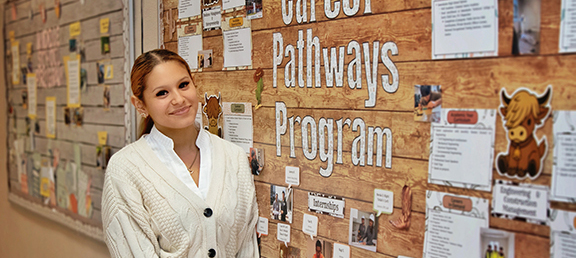
A perfect complement to the Foundation’s Career Pathways program, dual enrollment strengthens our students’ already robust exposure to diverse career paths. Participation often leads to higher college GPAs and increased graduation rates as students enter university with greater confidence and academic maturity.
Education & Human Services Pathway student Lucero has been participating in dual enrollment for over a year. She is currently taking the early childhood education course at Immokalee Technical College.
“I wanted to expand my academic horizons,” she explained. “What I love about dual enrollment is the hands-on aspect of it. Rather than just paper and pencil, I can see in real time how children grow and interact, how the brain works, and how our little humans perceive the world!”
Next year, Lucero will attend Florida Gulf Coast University and begin her Psychology degree program. Her ultimate goal is to become a Board-Certified Behavioral Analyst.